Mission
The mission of the Faculty of Health Studies is based on the Act on Higher Education and Scientific Activity of the Republic of Croatia, as well as on the Statute of the University of Rijeka and the Strategy of the University of Rijeka.
In a broader sense, the mission of the Faculty, as a public teaching and scientific institution, is the education and professional development of non-physician healthcare personnel, thereby contributing to the wider community through higher education, upbringing and the creation of reputable non-physician healthcare professionals.
The close integration of core activities contributes to the integration of scientific and professional results and knowledge into the educational process with the aim of achieving better, faster, comprehensive and sustainable development of the society in which we live.
FZSRI operates on the principles of scientific integrity and professional ethics.
Vision
The Faculty has the vision of positioning itself in the national and international environment as a leading, recognizable and competitive higher education, scientific and professional institution that is closely connected and adapted to the needs of the local and broader community.
In educational terms, the Faculty is developing as a higher education institution primarily recognized for educating non-physician healthcare personnel with a high level of acquired moral values, as well as knowledge and skills based on learning outcomes.
In the field of scientific research, FHSRI is developing into a recognizable scientific centre of biomedical and interdisciplinary research, with the aim of introducing modern scientific knowledge into everyday clinical practice.
In this way, the Faculty contributes to the wider community through upbringing, higher education and the creation of reputable non-physician healthcare professionals and scientists who improve the quality of health and life in society.
Welcome Message from the Dean
The Faculty of Health Studies of the University of Rijeka is the only faculty in the Republic of Croatia that is exclusively and entirely focused on undergraduate and graduate (university) education of non-physician healthcare personnel.
The Faculty of Health Studies, in the tradition it inherits from the Faculty of Medicine of the University of Rijeka, from which it originated, simultaneously performs and develops educational and scientific research activities. Therefore, we can proudly emphasize that during their studies our students acquire integrated subject knowledge and skills, the ability to independently and critically evaluate knowledge, solve specific problems, engage in research work, and, ultimately, gain an understanding of important ethical issues.
In addition to the high-quality educational process, studying in Rijeka is a pleasure due to numerous sports and social activities of student organizations, as well as the pleasant Mediterranean and Central European environment that our city offers.
Therefore, I invite you to visit our Faculty, become acquainted with the opportunities we offer, and choose one of our study programmes.
DEAN
Professor Daniela Malnar, PhD, MD
Brief History of the Building and the Faculty
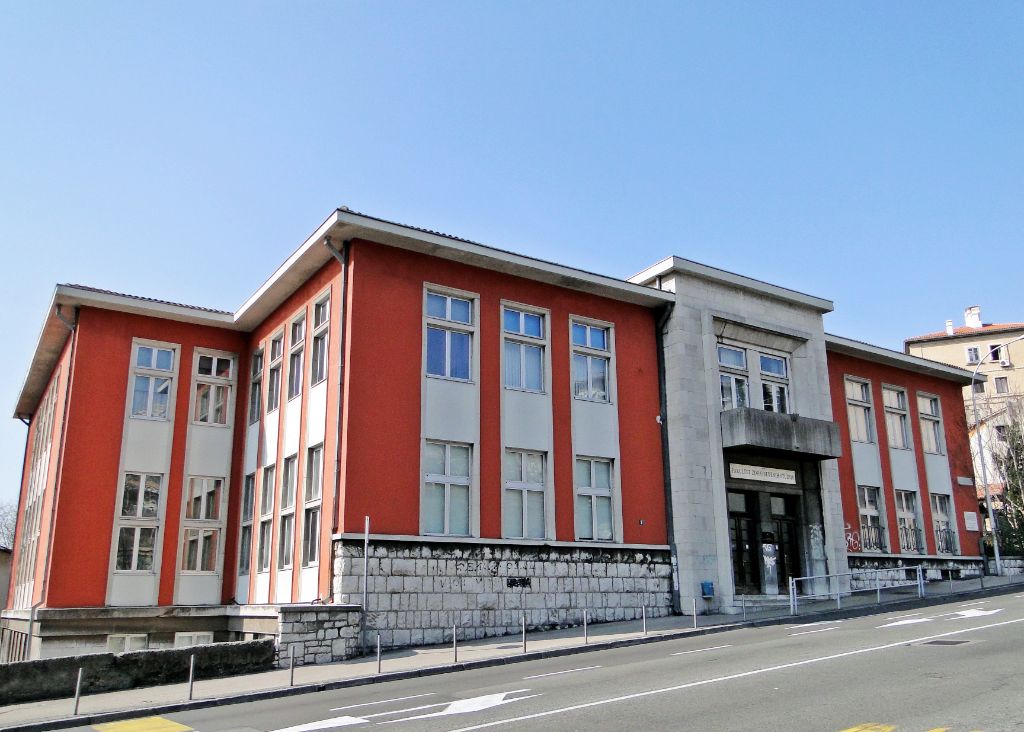
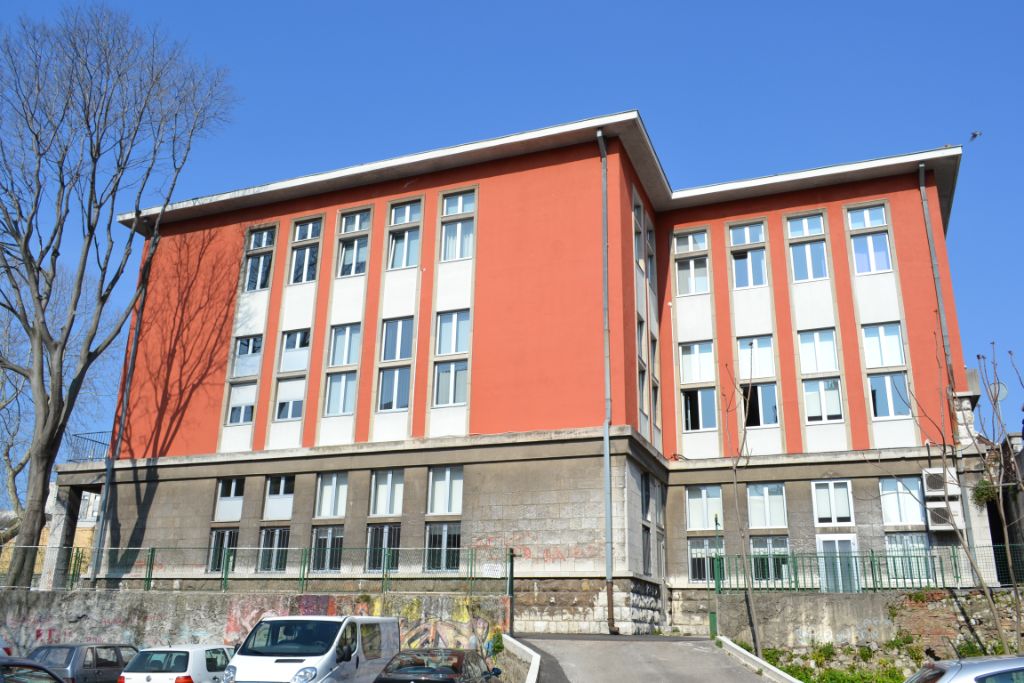
The building in which the Faculty of Health Studies is located today, at Viktora Cara Emina Street 5, was designed in the summer of 1942, during the period of Italian administration, as the “House of Municipal Care” (Casa dell’Assistenza, or according to the inscription on the façade and the name of the institution, Ente Comunale Assistenza), in the then Via Petrarca.
In the basement of the building (at street entrance level), a “paid dining room” (now Lecture Hall No. 6), a “free dining room” (now Lecture Hall No. 3), and a large kitchen (now a corridor and the Student Office) were designed.
In the right wing, where the Dean’s Office is located today, and beneath it, a “day hotel” (separate for men and women), a barber shop, a pedicure salon, and administrative offices were designed. On the first floor (now housing the Faculty departments and a computer classroom), there were dormitories, while in the basement (now the cafeteria, offices, and Lecture Halls No. 1 and 2) there were laundry facilities, ironing rooms, and spaces for disinfection of the House’s users.
As it was wartime, each floor also had an air-raid shelter (ricovero antiaereo).
Immediately after the end of the war, in 1947, the School for Nurses with a boarding facility moved into the building, with Pavica Defilipis as its first director.
The school, occasionally changing its name and organization, remained in the building until 1987, when the Faculty of Civil Engineering moved in, which was relocated at the end of 2011 to the Campus on Trsat.
During 2013, the building already partially hosted classes for students of the Faculty of Medicine, and from October 1, 2014, it became the headquarters of the newly established Faculty of Health Studies.